English| EUR
Suggested for you
More currencies
Choose a language
The mountain is visible from downtown on a clear morning, which fools a lot of first-time visitors into underestimating the journey. Between the city and the Nisqually gateway at Ashford lie roughly two and a half hours of interstate, river valley and forest road. This how to get to mount rainier from seattle guide sets out the realistic shape of that day before you commit to it.
Quick answer
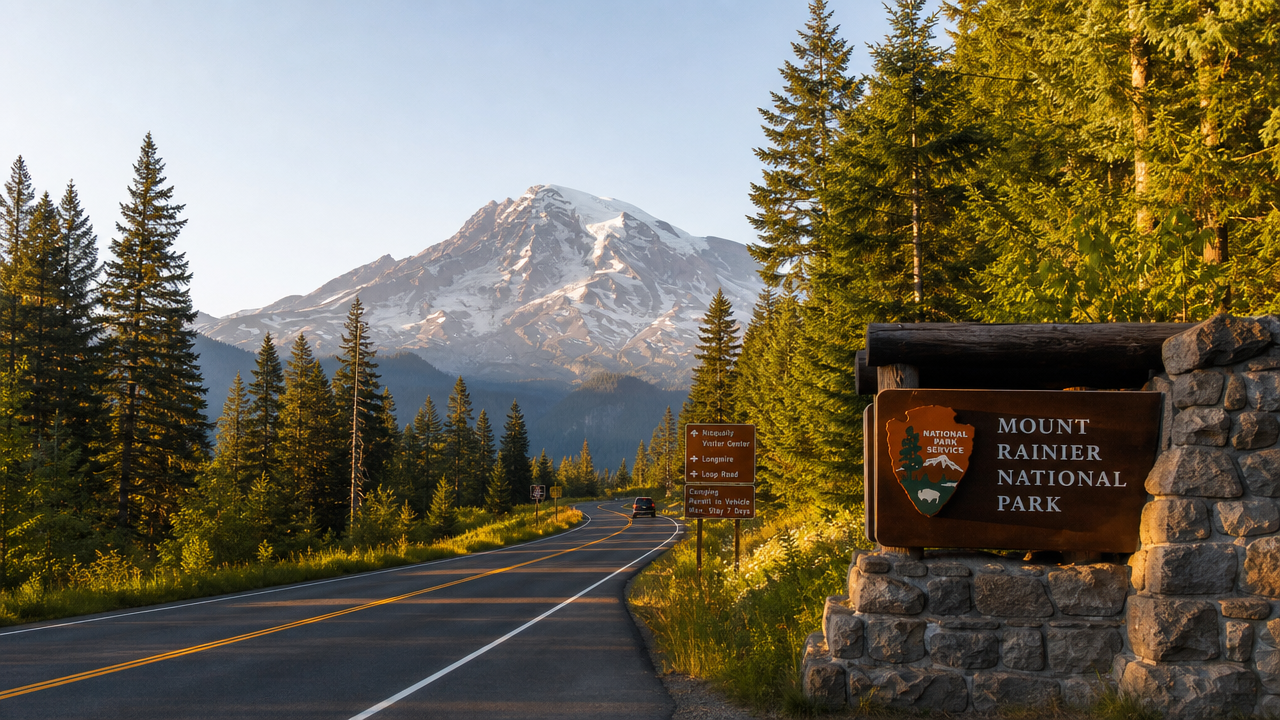
Mount Rainier's main southwest gateway sits at 39000 State Route 706 E, Ashford, WA 98304, around a two-to-three hour drive from Seattle depending on traffic and season. The park road system stays open 00:00–23:59 daily, but arriving between 06:00–09:30 is what secures parking in summer. Entry is charged per vehicle, not per person.
Mount Rainier is an active stratovolcano carrying more glacial ice than every other peak in the contiguous United States combined — twenty-five named glaciers, fed by some of the heaviest snowfall ever recorded in North America. That single geological fact explains most of what makes the journey from the city unusual. This is not a monument you walk up to. It is a 14,410-foot mountain wrapped in 236,000 acres of park, and the roads that reach it are seasonal, narrow and weather-dependent in ways that no distance figure on a map conveys. Anyone researching how to get to mount rainier from seattle is really asking three questions at once: which gateway, by what means, and at what hour. The park has several entrances, and they are not interchangeable. Nisqually, near Ashford on State Route 706, is the closest to the city and the only one open to vehicles year-round; it feeds Longmire and then Paradise, where the visitor centre, the subalpine meadows and most of the day-hiking sit. Sunrise, on the northeast side, is higher and often the better viewpoint, but it opens late in the season and adds substantially to the drive. Stevens Canyon and the Ohanapecosh corner belong to a different itinerary altogether. Choosing wrongly is the most common planning error, and it costs hours rather than minutes. The second complication is that public transport does not reach the park. There is no train, and no scheduled year-round bus from the city into the Nisqually entrance, which is why most visitors either rent a car or join a guided Seattle to Mount Rainier tour that handles the driving, the entrance formalities and the return leg. Either way, the constraint is the same: the Paradise parking area fills early on clear summer weekends, and there is no overflow solution once it does. Cell coverage thins beyond Elbe, so directions and reservations should be downloaded before leaving Ashford. What to do with all this is straightforward. Treat the mountain as a full day, not an afternoon detour. Build the plan around a single gateway rather than attempting two, check current road status before departure — the Nisqually–Paradise corridor is the reliable default — and set out early enough that the drive ends before the parking pressure begins. Understood that way, how to get to mount rainier from seattle becomes a question of sequencing rather than distance, and the answer holds up in almost any season.
“Treat the mountain as a full day, not an afternoon detour.”
Mount Rainier National Park is located southeast of Seattle, with the most direct access provided via the Nisqually Entrance in Ashford. Driving is the primary method for reaching the park, as public transit options are limited.
I-5 S to WA-512 E to WA-7 S to WA-706 E
Sound Transit Express 574 to Lakewood, then private shuttle or tour service
The park address is 39000 State Route 706 E, Ashford, WA 98304. To secure parking and avoid congestion, arrive between 06:00–09:30.
The best arrival window is 06:00–09:30 to avoid peak congestion and secure parking during high-visitation summer months. Arriving within this timeframe ensures access to popular trailheads before parking lots reach capacity.
Warm, 60°F–80°F
Expect full parking lots by mid-morning. Early entry is essential for access.
Cool, 45°F–65°F
Crowds decrease as schools resume. Mid-week visits offer more space.
Cold, 20°F–50°F
Snow limits vehicle access to higher elevations. Check road conditions before departing.
—
Arrivals before 09:30 provide the most reliable parking access. Weekend traffic significantly increases congestion.
Verdict: The optimal approach is to arrive between 06:00 and 09:30 on a weekday during the shoulder months of September or October.
Mount Rainier National Park remains open to visitors 24 hours a day throughout the week. Access is available year-round for those planning their transit from Seattle.
Work through these steps in order, from the weeks before your trip down to the morning you leave Seattle.
Everything you need to know about how to get to mount rainier from seattle
Travelers typically drive south via I-5 and SR-7 or SR-161, which takes approximately 2.5 to 3 hours depending on traffic. Understanding how to get to mount rainier from seattle requires planning for mountain road conditions. Private vehicle remains the most direct method for most visitors.
Guided options provide a stress-free alternative for those researching how to get to mount rainier from seattle. These tours handle the navigation and parking logistics, allowing you to focus on the scenic views and alpine meadows. It is a popular choice for visitors seeking a curated experience.
While many prefer driving, others consider shuttle services or private transport as a reliable way to reach this washington landmark. Planning how to get to mount rainier from seattle involves checking current road alerts on the official site. Always verify if your specific destination within the park, such as Paradise or Sunrise, is accessible.
The best arrival window is 06:00–09:30 to avoid peak congestion and secure parking during high-visitation summer months. Arriving early ensures you can explore subalpine wildflowers and glaciers before the afternoon crowds peak. Consistency in your morning schedule is key for a successful visit.
Visitors can utilize tour operators that offer transportation from the city to the park entrance. This removes the need for personal navigation and parking, which can be challenging during the busy season. Please review available transport listings to see how these services facilitate your trip.
The park charges an entrance fee of 30 USD per single vehicle, which is valid for 7 consecutive days. This fee supports the maintenance of trails, visitor centers, and road infrastructure. Be prepared to pay at the gate or display your pass if purchased in advance.
Driving time typically ranges from 2.5 to 3 hours from the city center to the park boundaries. Factors such as weekend traffic, weather, and construction can affect your total transit duration. We recommend checking real-time traffic updates before your departure.
Essentials include comfortable hiking boots, layers for changing weather, water, and snacks. Ensure you have a map of the park trails and glacier areas before heading out into the wilderness. Always stay on marked paths to protect the fragile alpine environment.